
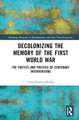
Decolonizing the Memory of the First World War: Routledge Research on Decoloniality and New Postcolonialisms
Autor Anna Branach-Kallasen Limba Engleză Paperback – 29 aug 2025
| Toate formatele și edițiile | Preț | Express |
|---|---|---|
| Paperback (1) | 483.90 lei 38-44 zile | |
| Routledge – 29 aug 2025 | 483.90 lei 38-44 zile | |
| Hardback (1) | 1013.77 lei 43-57 zile | |
| Taylor & Francis – apr 2024 | 1013.77 lei 43-57 zile |
Din seria Routledge Research on Decoloniality and New Postcolonialisms
-
 Preț: 310.36 lei
 -
 Preț: 333.44 lei
 -
 Preț: 339.77 lei
 -
 Preț: 335.29 lei
 - 25%
 Preț: 277.21 lei
 -
 Preț: 397.44 lei
 - 18%
 Preț: 960.82 lei
 -
 Preț: 450.16 lei
 - 24%
 Preț: 266.49 lei
 -
 Preț: 375.17 lei
 -
 Preț: 379.05 lei
 -
 Preț: 371.10 lei
 -
 Preț: 378.31 lei
 -
 Preț: 375.34 lei
 -
 Preț: 376.11 lei
 -
 Preț: 197.99 lei
 -
 Preț: 373.70 lei
 -
 Preț: 371.83 lei
 -
 Preț: 373.50 lei
 - 18%
 Preț: 1013.77 lei
 -
 Preț: 372.57 lei
 - 18%
 Preț: 1013.77 lei
 - 18%
 Preț: 1015.27 lei
Preț: 483.90 lei
Nou
Puncte Express: 726
Preț estimativ în valută:
85.62€ • 99.74$ • 74.76£
85.62€ • 99.74$ • 74.76£
Carte tipărită la comandă
Livrare economică 14-20 ianuarie 26
Preluare comenzi: 021 569.72.76
Specificații
ISBN-13: 9781032633220
ISBN-10: 1032633220
Pagini: 198
Dimensiuni: 156 x 234 x 11 mm
Greutate: 0.31 kg
Editura: Routledge
Seria Routledge Research on Decoloniality and New Postcolonialisms
ISBN-10: 1032633220
Pagini: 198
Dimensiuni: 156 x 234 x 11 mm
Greutate: 0.31 kg
Editura: Routledge
Seria Routledge Research on Decoloniality and New Postcolonialisms
Notă biografică
Anna Branach-Kallas is a professor at the Department of Anglophone Literature, Culture and Comparative Studies at Nicolaus Copernicus University in Toruń, Poland.
Cuprins
Introduction
Chapter One: Savagery, Epistemic Disobedience and Disabled Memory in At Night All Blood Is Black by David Diop
Chapter Two: Palimpsests of Disaster, Maroonage and the French Republican Discourse in Le Bataillon créole (Guerre de 1914-1918) by Raphaël Confiant
Chapter Three: Biopolitics, Dreams of Freedom and Multidirectional Memory in Dancing the Death Drill by Fred Khumalo
Chapter Four: Imperial Loyalties, Decolonial Insurgency and Potential History in A God in Every Stone by Kamila Shamsie
Chapter Five: The Colonial Modern, Mimicry and the Aesthetics/Ethics of Incompletion in Afterlives by Abdulrazak Gurnah
Conclusion
Chapter One: Savagery, Epistemic Disobedience and Disabled Memory in At Night All Blood Is Black by David Diop
Chapter Two: Palimpsests of Disaster, Maroonage and the French Republican Discourse in Le Bataillon créole (Guerre de 1914-1918) by Raphaël Confiant
Chapter Three: Biopolitics, Dreams of Freedom and Multidirectional Memory in Dancing the Death Drill by Fred Khumalo
Chapter Four: Imperial Loyalties, Decolonial Insurgency and Potential History in A God in Every Stone by Kamila Shamsie
Chapter Five: The Colonial Modern, Mimicry and the Aesthetics/Ethics of Incompletion in Afterlives by Abdulrazak Gurnah
Conclusion
Recenzii
Here is finally the much-needed book which investigates with insight and astuteness the work of contemporary novelists of colour responding to the First World War and unravelling its tangled ideologies and legacies. Powerful, passionate and perceptive, Decolonizing the Memory of the First World War shows how literature remains a singular force in challenging the colour of war memory, stretching its contours and replacing reductive vocabularies with ever-more difficult questions about ourselves and our pasts. This is a truly wonderful contribution to the conjoined worlds of war, memory and postcolonial studies.
-Professor Santanu Das, All Souls College, Oxford, UK
In her sophisticated and fully contextualised decolonial analysis of First World War novels, Anna Branach-Kallas reveals how contemporary authors' evocation of minoritized experiences of war and empire helps us to see afresh the traumatic legacies of the conflict on those who fought it. This book will be of great interest to researchers and students in both literature and history departments.
-Professor Alison Fell, University of Liverpool, UK
Combining First World War studies and postcolonial studies, this book makes a vital contribution to countering Eurocentric memories of the Great War. It provides gripping analyses of centenary novels that expose the racial ideologies which have made the experience of coloured colonial soldiers a sadly neglected history.
-Professor Martin Löschnigg, University of Graz, Austria
Much as the literature of the First World War has prospered in numerous countries for decades, writers have, to date, largely overlooked contributions by soldiers of colour. Providentially, their previous commitments are now analyzed in two French novels, one British novel, one novel from South Africa and one woman’s Pakistani novel, all of whom, according to Anna Branach-Kallas, share an intention to decolonize their memories of the First World War.
-Dr Donna Coates, Associate Professor Emerita, University of Calgary, Canada
-Professor Santanu Das, All Souls College, Oxford, UK
In her sophisticated and fully contextualised decolonial analysis of First World War novels, Anna Branach-Kallas reveals how contemporary authors' evocation of minoritized experiences of war and empire helps us to see afresh the traumatic legacies of the conflict on those who fought it. This book will be of great interest to researchers and students in both literature and history departments.
-Professor Alison Fell, University of Liverpool, UK
Combining First World War studies and postcolonial studies, this book makes a vital contribution to countering Eurocentric memories of the Great War. It provides gripping analyses of centenary novels that expose the racial ideologies which have made the experience of coloured colonial soldiers a sadly neglected history.
-Professor Martin Löschnigg, University of Graz, Austria
Much as the literature of the First World War has prospered in numerous countries for decades, writers have, to date, largely overlooked contributions by soldiers of colour. Providentially, their previous commitments are now analyzed in two French novels, one British novel, one novel from South Africa and one woman’s Pakistani novel, all of whom, according to Anna Branach-Kallas, share an intention to decolonize their memories of the First World War.
-Dr Donna Coates, Associate Professor Emerita, University of Calgary, Canada