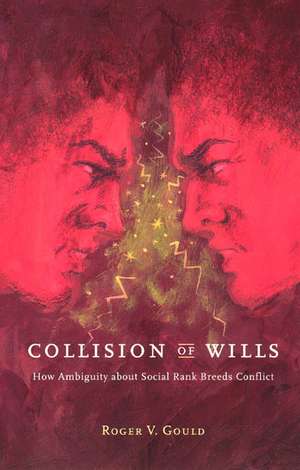
Collision of Wills: How Ambiguity about Social Rank Breeds Conflict
Autor Roger V. Goulden Limba Engleză Paperback – 15 oct 2003
Minor debts, derisive remarks, a fight over a parking space, butting in line—these are the little things that nevertheless account for much of the violence in human society. But why? Roger V. Gould considers this intriguing question in Collision of Wills. He argues that human conflict is more likely to occur in symmetrical relationships—among friends or social equals—than in hierarchical ones, wherein the difference of social rank between the two individuals is already established.
This, he maintains, is because violence most often occurs when someone wants to achieve superiority or dominance over someone else, even if there is no substantive reason for doing so. In making the case for this original idea, Gould explores a diverse range of examples, including murders, blood feuds, vendettas, revolutions, and the everyday disagreements that compel people to act violently. The result is an intelligent and provocative work that restores the study of conflict to the center of social inquiry.
This, he maintains, is because violence most often occurs when someone wants to achieve superiority or dominance over someone else, even if there is no substantive reason for doing so. In making the case for this original idea, Gould explores a diverse range of examples, including murders, blood feuds, vendettas, revolutions, and the everyday disagreements that compel people to act violently. The result is an intelligent and provocative work that restores the study of conflict to the center of social inquiry.
| Toate formatele și edițiile | Preț | Express |
|---|---|---|
| Paperback (1) | 239.62 lei 43-57 zile | |
| University of Chicago Press – 15 oct 2003 | 239.62 lei 43-57 zile | |
| Hardback (1) | 609.67 lei 22-36 zile | +20.37 lei 6-12 zile |
| University of Chicago Press – 15 oct 2003 | 609.67 lei 22-36 zile | +20.37 lei 6-12 zile |
Preț: 239.62 lei
Nou
Puncte Express: 359
Preț estimativ în valută:
42.40€ • 49.39$ • 37.02£
42.40€ • 49.39$ • 37.02£
Carte tipărită la comandă
Livrare economică 19 ianuarie-02 februarie 26
Preluare comenzi: 021 569.72.76
Specificații
ISBN-13: 9780226305509
ISBN-10: 0226305503
Pagini: 224
Ilustrații: 1 halftone, 1 figure, 17 tables
Dimensiuni: 140 x 216 x 23 mm
Greutate: 0.31 kg
Ediția:First Edition
Editura: University of Chicago Press
Colecția University of Chicago Press
ISBN-10: 0226305503
Pagini: 224
Ilustrații: 1 halftone, 1 figure, 17 tables
Dimensiuni: 140 x 216 x 23 mm
Greutate: 0.31 kg
Ediția:First Edition
Editura: University of Chicago Press
Colecția University of Chicago Press
V-ar putea interesa
-
 Regarding the Pain of OthersSusan Sontag-29%Preț: 57.42 lei80.45 lei
 -
 SlaveryStanley Engerman-7%Preț: 315.05 lei338.26 lei
 -
 -20%Preț: 510.36 lei641.08 lei
 -
 -30%Preț: 401.40 lei569.77 lei
 -
 Transgressive ImaginationsM. O'Neill-15%Preț: 615.35 lei723.94 lei
 -
 Ill Effects: The Media Violence DebateMartin BarkerPreț: 357.50 lei
 -
 -30%Preț: 77.44 lei111.17 lei
 -
 From God's Monster To The Devil's AngelPacc ButlerPreț: 79.43 lei
 -
 Preț: 420.32 lei
 -
 Violent Conflicts in Indonesia: Analysis, Representation, ResolutionCharles A. Coppel-50%Preț: 532.58 lei1073.49 lei
 -
 A Crime So MonstrousE Benjamin SkinnerPreț: 114.11 lei
 -
 Preț: 281.88 lei
 -
 Cartas a mi amiga maltratadaDavid HormacheaPreț: 63.61 lei
 -
 Preț: 337.31 lei
 -
 The Insanity of NormalityArno GruenPreț: 92.16 lei
 -
 The Psychology of Interpersonal ViolenceClive R. HollinPreț: 425.91 lei
 -
 Gunst, L: Born Fi' DeadLaurie GunstPreț: 74.85 lei
 -
 Dirie, W: Desert ChildrenWaris Dirie-28%Preț: 53.72 lei74.96 lei
 -
 The Taxman: The True Story of the Hardest Man in BritainBrian Cockerill-21%Preț: 54.27 lei68.38 lei
 -
 Tackling Child NeglectGARDNER RUTH-24%Preț: 220.93 lei290.32 lei
 -
 Breaking Down The Wall Of SilenceAlice Miller-29%Preț: 53.10 lei74.58 lei
Notă biografică
Roger V. Gould was a professor of sociology at Yale University and visiting scholar at the Russell Sage Foundation when he died in 2002. He wrote Insurgent Identities and edited The Rational Choice Controversy in Historical Sociology, both published by the University of Chicago Press.
Cuprins
Foreword by Peter Bearman
1. Conflict, Honor, and Hierarchy
2. Dominance Relations
3. Strife out of Symmetry
4. Solidarity and Group Conflict
5. Conflict and Social Structure
6. Honor and the Individual
References
Index
1. Conflict, Honor, and Hierarchy
2. Dominance Relations
3. Strife out of Symmetry
4. Solidarity and Group Conflict
5. Conflict and Social Structure
6. Honor and the Individual
References
Index
Recenzii
“Gould is to be commended for sensitizing us to the neglected topic of social-ranking competition and its relation to violence.”
“[Gould] brings his ideas to bear on an impressive range of data from diverse cultures and times: a relatively rare occurrence in a field where most social scientists focus only on violence in modern America. . . His writing is elegant, lucid, and laced throughout with a sharp and incisive wit.”
“Collision of Wills persuades us that conflicts arise in social relations where people are unclear about their rank. It is an idea that goes back to Durkheim’s Suicide, which this work very much resembles. Consistently smart and ambitious, often controversial, and occasionally quixotic, this book is likely to become a small classic.”