
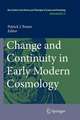
Change and Continuity in Early Modern Cosmology: Archimedes, cartea 27
Editat de Patrick Bonneren Limba Engleză Hardback – 30 noi 2010
| Toate formatele și edițiile | Preț | Express |
|---|---|---|
| Paperback (1) | 610.96 lei 6-8 săpt. | |
| SPRINGER NETHERLANDS – 2 ian 2013 | 610.96 lei 6-8 săpt. | |
| Hardback (1) | 616.15 lei 6-8 săpt. | |
| SPRINGER NETHERLANDS – 30 noi 2010 | 616.15 lei 6-8 săpt. |
Din seria Archimedes
- 18%
 Preț: 756.34 lei
 - 15%
 Preț: 624.95 lei
 - 5%
 Preț: 873.81 lei
 - 24%
 Preț: 726.43 lei
 - 18%
 Preț: 864.31 lei
 - 18%
 Preț: 919.64 lei
 -
 Preț: 367.85 lei
 - 18%
 Preț: 1761.77 lei
 - 15%
 Preț: 618.99 lei
 - 18%
 Preț: 914.83 lei
 - 15%
 Preț: 620.86 lei
 - 15%
 Preț: 619.45 lei
 - 18%
 Preț: 1059.78 lei
 - 15%
 Preț: 615.66 lei
 - 18%
 Preț: 1061.16 lei
 - 18%
 Preț: 1268.75 lei
 - 18%
 Preț: 701.79 lei
 - 18%
 Preț: 1637.69 lei
 - 18%
 Preț: 856.89 lei
 - 18%
 Preț: 746.82 lei
 - 18%
 Preț: 1167.33 lei
 - 18%
 Preț: 1069.97 lei
 - 18%
 Preț: 747.59 lei
 - 18%
 Preț: 957.15 lei
 - 15%
 Preț: 610.96 lei
 - 24%
 Preț: 1579.42 lei
 - 18%
 Preț: 911.64 lei
 - 18%
 Preț: 1601.95 lei
 - 18%
 Preț: 1071.48 lei
 - 15%
 Preț: 620.68 lei
 - 15%
 Preț: 611.57 lei
 - 18%
 Preț: 751.66 lei
Preț: 616.15 lei
Preț vechi: 724.89 lei
-15% Nou
Puncte Express: 924
Preț estimativ în valută:
109.06€ • 127.13$ • 95.38£
109.06€ • 127.13$ • 95.38£
Carte tipărită la comandă
Livrare economică 20 ianuarie-03 februarie 26
Preluare comenzi: 021 569.72.76
Specificații
ISBN-13: 9789400700369
ISBN-10: 9400700369
Pagini: 230
Ilustrații: XII, 181 p.
Dimensiuni: 155 x 235 x 20 mm
Greutate: 0.43 kg
Ediția:2011
Editura: SPRINGER NETHERLANDS
Colecția Springer
Seria Archimedes
Locul publicării:Dordrecht, Netherlands
ISBN-10: 9400700369
Pagini: 230
Ilustrații: XII, 181 p.
Dimensiuni: 155 x 235 x 20 mm
Greutate: 0.43 kg
Ediția:2011
Editura: SPRINGER NETHERLANDS
Colecția Springer
Seria Archimedes
Locul publicării:Dordrecht, Netherlands
V-ar putea interesa
-
 The InformationJames GleickPreț: 103.62 lei
 -
 Preț: 103.37 lei
 -
 Preț: 108.49 lei
 -
 The Oxford Book of Modern Science WritingRichard Dawkins-17%Preț: 85.46 lei103.25 lei
 -
 Michael Faraday: A Very Short IntroductionFrank A.J.L James-21%Preț: 53.44 lei67.88 lei
 -
 Selected WritingsGalileo-20%Preț: 66.91 lei83.16 lei
 -
 From Melancholia to Prozac: A history of depressionClark Lawlor-20%Preț: 96.40 lei120.53 lei
 -
 Sand and Silicon: Science that Changed the WorldDenis McWhan-31%Preț: 455.33 lei662.04 lei
 -
 Plastic Fantastic: How the Biggest Fraud in Physics Shook the Scientific WorldEugenie Samuel ReichPreț: 111.29 lei
 -
 Affect and Artificial IntelligenceElizabeth A. WilsonPreț: 249.08 lei
 -
 -11%Preț: 433.32 lei486.88 lei
 -
 The Madame Curie Complex: The Hidden History of Women in ScienceJulie Des JardinsPreț: 122.36 lei
 -
 The Fallen Sky: An Intimate History of Shooting StarsChristopher CokinosPreț: 148.36 lei
 -
 QuantumManjit KumarPreț: 90.52 lei
 -
 History of Science: A Beginner's GuideSean F. JohnstonPreț: 69.09 lei
Public țintă
ResearchCuprins
1. Acknowledgments.- 2. Notes on Contribtutors.- 3. Introduction.- 4. The Reality of Peurbachs Orbs , (Barker).- 5. Continuity and change in cosmological ideas in Spain between the sixteenth and seventeenth centuries, (Navarro Brontos).- 6. Cornelius Gemma and the new star of 1572 ,(Tessicini).- 7. Johannes Kepler and David Fabricius: their discussion on the nova of 1604, Grandada.- 8. Kepler’s copernican campaign and the new star of1604 , (Boner).- 9. From cosmos to confession:.- Kepler and the connection between astronomical and religious truth, (Rothman).- 10. Johannes phocylides holwarda and the interpretation of new stars in the dutch republic, (Vermij).- 11. Discovering mira ceti:celestial change & cosmic continuity, (Hatch).
Recenzii
From the reviews:
“This collection of essays, originally written for a conference held at Johns Hopkins in 2009 … . ‘New stars’ have long captured the attention of historians, but to my knowledge this is the first set of studies to focus on how early modern astronomers dealt with new stars from 1572 to the late seventeenth century. … A particular strength of this volume is its expansion beyond Kepler and Galileo to the larger communities engaged in astronomical and mathematical pursuits.” (Richard Oosterhoff, British Journal for the History of Science, Vol. 45 (3), September, 2012)
“This collection of essays, originally written for a conference held at Johns Hopkins in 2009 … . ‘New stars’ have long captured the attention of historians, but to my knowledge this is the first set of studies to focus on how early modern astronomers dealt with new stars from 1572 to the late seventeenth century. … A particular strength of this volume is its expansion beyond Kepler and Galileo to the larger communities engaged in astronomical and mathematical pursuits.” (Richard Oosterhoff, British Journal for the History of Science, Vol. 45 (3), September, 2012)
Textul de pe ultima copertă
Viewed as a flashpoint of the Scientific Revolution, early modern astronomy witnessed a virtual explosion of ideas about the nature and structure of the world. This study explores these theories in a variety of intellectual settings, challenging our view of modern science as a straightforward successor to Aristotelian natural philosophy. It shows how astronomers dealt with celestial novelties by deploying old ideas in new ways and identifying more subtle notions of cosmic rationality. Beginning with the celestial spheres of Peurbach and ending with the evolutionary implications of the new star Mira Ceti, it surveys a pivotal phase in our understanding of the universe as a place of constant change that confirmed deeper patterns of cosmic order and stability.
Caracteristici
Features articles that challenge our historical view of science in new ways Provides the most comprehensive historical study of the new stars of 1572 and 1604 Contributes a superior understanding of the role of astrology in early modern science Surveys the history of science in Spain and other neglected countries