
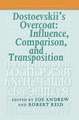
Aspects of Dostoevskii: Art, Ethics and Faith: Studies in Slavic Literature and Poetics, cartea 57
Robert Reid, Joe Andrewen Limba Engleză Paperback – 31 dec 2011



Preț: 664.98 lei
Preț vechi: 773.24 lei
-14% Nou
Puncte Express: 997
Preț estimativ în valută:
117.65€ • 137.07$ • 102.74£
117.65€ • 137.07$ • 102.74£
Carte tipărită la comandă
Livrare economică 19 ianuarie-02 februarie 26
Preluare comenzi: 021 569.72.76
Specificații
ISBN-13: 9789042035140
ISBN-10: 9042035145
Pagini: 306
Dimensiuni: 155 x 235 x 18 mm
Greutate: 0.5 kg
Editura: Brill
Colecția Brill
Seria Studies in Slavic Literature and Poetics
ISBN-10: 9042035145
Pagini: 306
Dimensiuni: 155 x 235 x 18 mm
Greutate: 0.5 kg
Editura: Brill
Colecția Brill
Seria Studies in Slavic Literature and Poetics
V-ar putea interesa
-
 Emma's WarDeborah ScrogginsPreț: 89.27 lei
 -
 In The Time Of MadnessRichard Lloyd Parry-21%Preț: 70.11 lei88.63 lei
 -
 Postwar Japan as History (Paper)Andrew GordonPreț: 292.43 lei
 -
 Understanding Vietnam (Paper)Neil L. JamiesonPreț: 250.90 lei
 -
 The Search for Neofascism: The Use and Abuse of Social ScienceA. James GregorPreț: 282.38 lei
 -
 Ivan's WarCatherine MerridalePreț: 89.87 lei
 -
 Preț: 375.79 lei
 -
 -23%Preț: 416.81 lei541.30 lei
 -
 American Culture in the 1990sDr. Colin Harrison-15%Preț: 191.83 lei224.93 lei
 -
 The 1960sB WardPreț: 360.06 lei
 -
 Preț: 328.90 lei
 -
 Queen BeesSian Evans-27%Preț: 65.07 lei89.55 lei
 -
 Books for BurningAntonio NegriPreț: 230.08 lei
 -
 The Vanishing Map: A Journey from LA to Tokyo to the Heart of EuropeDr Stephen Barber-39%Preț: 253.70 lei416.57 lei
 -
 Making War in Cote D'Ivoire: South Asians in BritainMike McGovern-24%Preț: 158.76 lei208.71 lei
 -
 Seawomen of Iceland: Survival on the EdgeMargaret Willson-12%Preț: 318.85 lei363.85 lei
Cuprins
Preface
Notes on Contributors
Robert Reid: Introduction: Aspects of Dostoevskii: Art, Ethics and Faith
Katalin Kroó: Intermediary Semantic Formations in White Nights
Audun J. Mørch: The Chronotope of Freedom: House of the Dead
Sarah Hudspith: Why We Must Laugh at the Underground Man
Hristo Manolakev: The Murder Plot in Crime and Punishment: A New Reading
Olga Soboleva: Images Are Created to Be Destroyed (Photography and Painting in The Idiot)
Diane Oenning Thompson: On the Koranic Motif in The Idiot and Demons
Robin Milner-Gulland and Olga Soboleva: ‘Excellent material, I see’: What Happens in Bobok?
Leon Burnett: Effacement and Enigma in the Making of The Meek Girl
Robin Aizlewood: The Dream of a Ridiculous Man: Both Knowing and Not Knowing, and Questions of Philosophy
Joe Andrew: For Men Only? Dostoevskii’s Patriarchal Vision in The Brothers Karamazov
Katherine Jane Briggs: ‘Women of Faith’ or ‘Ladies of Little Faith’: Mothers and Daughters in The Brothers Karamazov
Robin Feuer Miller: Friendly Persuasion and Divine Conversation in The Brothers Karamazov
Richard Peace: One Little Onion and a Pound of Nuts: The Theme of Giving and Accepting in The Brothers Karamazov
Cleo Protokhristova: Time v. Narrative in The Brothers Karamazov
Notes on Contributors
Robert Reid: Introduction: Aspects of Dostoevskii: Art, Ethics and Faith
Katalin Kroó: Intermediary Semantic Formations in White Nights
Audun J. Mørch: The Chronotope of Freedom: House of the Dead
Sarah Hudspith: Why We Must Laugh at the Underground Man
Hristo Manolakev: The Murder Plot in Crime and Punishment: A New Reading
Olga Soboleva: Images Are Created to Be Destroyed (Photography and Painting in The Idiot)
Diane Oenning Thompson: On the Koranic Motif in The Idiot and Demons
Robin Milner-Gulland and Olga Soboleva: ‘Excellent material, I see’: What Happens in Bobok?
Leon Burnett: Effacement and Enigma in the Making of The Meek Girl
Robin Aizlewood: The Dream of a Ridiculous Man: Both Knowing and Not Knowing, and Questions of Philosophy
Joe Andrew: For Men Only? Dostoevskii’s Patriarchal Vision in The Brothers Karamazov
Katherine Jane Briggs: ‘Women of Faith’ or ‘Ladies of Little Faith’: Mothers and Daughters in The Brothers Karamazov
Robin Feuer Miller: Friendly Persuasion and Divine Conversation in The Brothers Karamazov
Richard Peace: One Little Onion and a Pound of Nuts: The Theme of Giving and Accepting in The Brothers Karamazov
Cleo Protokhristova: Time v. Narrative in The Brothers Karamazov
Recenzii
"[A]n intriguing collection to ponder, particularly for those who are interested in the artistic and metaphysical questions which traverse the discrete texts of Dostoevsky’s work as a whole. […] The editors, Reid and Andrew, along with the tome’s contributors, are to be congratulated on the high quality of the volume and its significant addition to Dostoevsky scholarship."
- Eugenia Kapsomera Amditis (Westchester), in Slavic and East European Journal Vol.58.1 2014, pp. 144-5.
"Reid also emphasizes Dostoevsky’s continuing relevance, and suggests this may be related not only to the power of his own works, but also to the fact that Dostoevsky stands behind Bakhtin’s theories, which have enjoyed so much popularity in academic circles and beyond in recent years. Dostoevsky certainly continues to attract a wide range of scholarly debate, and this lively and effective volume makes a sound contribution to the field, and will be useful for students as well as researchers."
- Sarah J. Young (University College London), in SLAVONICA Vol. 19 No. 1, April 2013. pp. 69-70.
"This excellent collection of fourteen articles addresses the most gripping concepts inseparable from any interpretation of Dostoevskii's work. […] The high quality of individual contributions results in an informed and organic 'polylogue,' a professional round-table, which should be the aim of any such collective scholarly endeavor."
- Marina Kostalevsky (Bard College), in The Russian Review April 2013.
- Eugenia Kapsomera Amditis (Westchester), in Slavic and East European Journal Vol.58.1 2014, pp. 144-5.
"Reid also emphasizes Dostoevsky’s continuing relevance, and suggests this may be related not only to the power of his own works, but also to the fact that Dostoevsky stands behind Bakhtin’s theories, which have enjoyed so much popularity in academic circles and beyond in recent years. Dostoevsky certainly continues to attract a wide range of scholarly debate, and this lively and effective volume makes a sound contribution to the field, and will be useful for students as well as researchers."
- Sarah J. Young (University College London), in SLAVONICA Vol. 19 No. 1, April 2013. pp. 69-70.
"This excellent collection of fourteen articles addresses the most gripping concepts inseparable from any interpretation of Dostoevskii's work. […] The high quality of individual contributions results in an informed and organic 'polylogue,' a professional round-table, which should be the aim of any such collective scholarly endeavor."
- Marina Kostalevsky (Bard College), in The Russian Review April 2013.