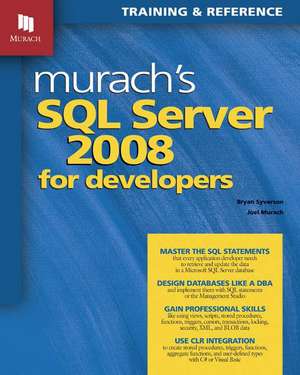
Murach's SQL Server 2008
Autor Bryan Syverson, Joel Murachen Paperback – 31 dec 2008
Preț: 267.55 lei
Preț vechi: 302.22 lei
-11%
Puncte Express: 401
Carte indisponibilă temporar
Doresc să fiu notificat când acest titlu va fi disponibil:
Se trimite...
Specificații
ISBN-13: 9781890774516
ISBN-10: 1890774510
Pagini: 780
Ilustrații: 316 b/w illus
Dimensiuni: 250 x 200 mm
Greutate: 1.56 kg
Editura: Mike Murach & Associates, Inc
Colecția Murach (Mike) & Associates Inc (US)
ISBN-10: 1890774510
Pagini: 780
Ilustrații: 316 b/w illus
Dimensiuni: 250 x 200 mm
Greutate: 1.56 kg
Editura: Mike Murach & Associates, Inc
Colecția Murach (Mike) & Associates Inc (US)
Cuprins
An introduction to SQL; An introduction to relational databases and SQL; How to use the Management Studio; How to retrieve data from a single table; How to retrieve data from two or more tables; How to code summary queries; How to code subqueries; How to insert, update, and delete data; How to work with data types and functions; How to design a database; How to create and maintain databases and tables with SQL statements; How to use the Management Studio for database design; How to work with views; How to code scripts; How to code stored procedures, functions, and triggers; How to work with cursors; How to manage transactions and locking; How to manage database security; How to work with XML; How to work with BLOBs; An introduction to CLR integration; How to code CLR stored procedures, functions, and triggers; How to code aggregate functions and user-defined types; Index.