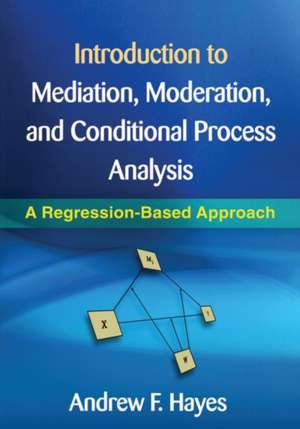
Introduction to Mediation, Moderation, and Conditional Process Analysis: Methodology in the Social Sciences
Autor Andrew F. Hayesen Limba Engleză Hardback – 13 iun 2013
This book is aimed at an audience of applied researchers in psychology, human development, education, sociology, public health, communication, and management; graduate students and instructors. It will serve as a core book or supplement in graduate courses on quantitative data analysis, regression, or multivariate analysis.
Din seria Methodology in the Social Sciences
-
 Preț: 418.14 lei
 - 8%
 Preț: 502.75 lei
 - 15%
 Preț: 587.06 lei
 - 9%
 Preț: 656.34 lei
 - 8%
 Preț: 597.36 lei
 -
 Preț: 424.44 lei
 - 8%
 Preț: 503.97 lei
 - 8%
 Preț: 464.73 lei
 - 15%
 Preț: 467.65 lei
 - 8%
 Preț: 429.44 lei
 - 15%
 Preț: 553.37 lei
 -
 Preț: 325.66 lei
 -
 Preț: 369.42 lei
 -
 Preț: 491.16 lei
 -
 Preț: 412.35 lei
 - 26%
 Preț: 346.44 lei
 - 12%
 Preț: 353.85 lei
 - 26%
 Preț: 381.57 lei
 - 16%
 Preț: 326.76 lei
 - 9%
 Preț: 506.26 lei
Preț: 320.84 lei
Puncte Express: 481
Carte indisponibilă temporar
Doresc să fiu notificat când acest titlu va fi disponibil:
Se trimite...
Specificații
ISBN-13: 9781609182304
ISBN-10: 1609182308
Pagini: 507
Ilustrații: illustrations
Dimensiuni: 175 x 260 x 19 mm
Greutate: 1.09 kg
Editura: Guilford Publications
Seria Methodology in the Social Sciences
ISBN-10: 1609182308
Pagini: 507
Ilustrații: illustrations
Dimensiuni: 175 x 260 x 19 mm
Greutate: 1.09 kg
Editura: Guilford Publications
Seria Methodology in the Social Sciences
Cuprins
Part I: Fundamental Concepts. Introduction. A Scientist in Training. Questions of Whether, If, How, and When. Conditional Process Analysis. Correlation, Causality, and Statistical Modeling. Statistical Software. Overview of this Book. Chapter Summary. Simple Linear Regression. Correlation and Prediction. The Simple Linear Regression Equation. Statistical Inference. Assumptions for Interpretation and Statistical Inference. Chapter Summary. Multiple Linear Regression. The Multiple Linear Regression Equation. Partial Association and Statistical Control. Statistical Inference in Multiple Regression. Statistical and Conceptual Diagrams. Chapter Summary. Part II: Mediation Analysis. The Simple Mediation Model. Estimation of the Direct, Indirect, and Total Effects of X. Example with Dichotomous X: The Influence of Presumed Media Influence. Statistical Inference.In Example with Continuous X: Economic Stress among Small Business Owners. Chapter Summary. Multiple Mediator Models. The Parallel Multiple Mediator Model. Example Using the Presumed Media Influence Study. Statistical Inference. The Serial Multiple Mediator Model. Complementarity and Competition among Mediators. OLS Regression versus Structural Equation Modeling. Chapter Summary. Part III: Moderation Analysis. Miscellaneous Topics in Mediation Analysis. What About Baron and Kenny? Confounding and Causal Order. Effect Size. Multiple Xs or Ys: Analyze Separately or Simultaneously? Reporting a Mediation Analysis. Chapter Summary. Fundamentals of Moderation Analysis. Conditional and Unconditional Effects. An Example: Sex Discrimination in the Workplace. Visualizing Moderation. Probing an Interaction. Chapter Summary. Extending Moderation Analysis Principles. Moderation Involving a Dichotomous Moderator. Interaction between Two Quantitative Variables. Hierarchical versus Simultaneous Variable Entry. The Equivalence between Moderated Regression Analysis and a 2 × 2 Factorial Analysis of Variance. Chapter Summary. Miscellaneous Topics in Moderation Analysis. Truths and Myths about Mean Centering. The Estimation and Interpretation of Standardized Regression Coefficients in a Moderation Analysis. Artificial Categorization and Subgroups Analysis. More Than One Moderator. Reporting a Moderation Analysis. Chapter Summary. Part IV: Conditional Process Analysis. Conditional Process Analysis. Examples of Conditional Process Models in the Literature. Conditional Direct and Indirect Effects. Example: Hiding Your Feelings from Your Work Team. Statistical Inference. Conditional Process Analysis in PROCESS. Chapter Summary. Further Examples of Conditional Process Analysis. Revisiting the Sexual Discrimination Study. Moderation of the Direct and Indirect Effects in a Conditional Process Model. Visualizing the Direct and Indirect Effects. Mediated Moderation. Chapter Summary. Miscellaneous Topics in Conditional Process Analysis. A Strategy for Approaching Your Analysis. Can a Variable Simultaneously Mediate and Moderate Another Variable’s Effect? Comparing Conditional Indirect Effects and a Formal Test of Moderated Mediation. The Pitfalls of Subgroups Analysis. Writing about Conditional Process Modeling. Chapter Summary. Appendix A. Using PROCESS. Appendix B. Monte Carlo Confidence Intervals in SPSS and SAS.
Recenzii
"Mediation and moderation are two of the most widely used statistical tools in the social sciences. Students and experienced researchers have been waiting for a clear, engaging, and comprehensive book on these topics for years, but the wait has been worth it--this book is an absolute winner. With his usual clarity, Hayes has written what will become the default resource on mediation and moderation for many years to come." - Andy Field, PhD, School of Psychology, University of Sussex, United Kingdom
"Hayes provides an accessible, thorough introduction to the analysis of models containing mediators, moderators, or both. The text is easy to follow and written at a level appropriate for an introductory graduate course on mediation and moderation analysis. The book is also an extremely useful resource for applied researchers interested in analyzing conditional process models. One strength is the inclusion of numerous examples using real data, with step-by-step instructions for analysis of the data and interpretation of the results. This book's largest contribution to the field is its replacement of the confusing terminology of mediated moderation and moderated mediation with the clearer and broader term conditional process model." - Matthew Fritz, PhD, Virginia Polytechnic Institute and State University, USA
"A welcome contribution. This book's accessible language and diverse set of examples will appeal to a wide variety of substantive researchers looking to explore how or why, and under what conditions, relationships among variables exist. Hayes has a unique ability to effectively communicate technical material to nontechnical audiences. He facilitates application of several cutting-edge statistical models by providing practical, well-oiled machinery for conducting the analyses in practice. I can use this book to enhance my graduate-level mediation class by extending the course to include more coverage on differentiating mediation versus moderation and on conditional process models that simultaneously evaluate both effects together." - Amanda Jane Fairchild, PhD, University of South Carolina, USA
"Hayes provides an accessible, thorough introduction to the analysis of models containing mediators, moderators, or both. The text is easy to follow and written at a level appropriate for an introductory graduate course on mediation and moderation analysis. The book is also an extremely useful resource for applied researchers interested in analyzing conditional process models. One strength is the inclusion of numerous examples using real data, with step-by-step instructions for analysis of the data and interpretation of the results. This book's largest contribution to the field is its replacement of the confusing terminology of mediated moderation and moderated mediation with the clearer and broader term conditional process model." - Matthew Fritz, PhD, Virginia Polytechnic Institute and State University, USA
"A welcome contribution. This book's accessible language and diverse set of examples will appeal to a wide variety of substantive researchers looking to explore how or why, and under what conditions, relationships among variables exist. Hayes has a unique ability to effectively communicate technical material to nontechnical audiences. He facilitates application of several cutting-edge statistical models by providing practical, well-oiled machinery for conducting the analyses in practice. I can use this book to enhance my graduate-level mediation class by extending the course to include more coverage on differentiating mediation versus moderation and on conditional process models that simultaneously evaluate both effects together." - Amanda Jane Fairchild, PhD, University of South Carolina, USA
Notă biografică
Andrew F. Hayes, PhD, is Professor of Quantitative Psychology and Professor of Communication at The Ohio State University. He is the author of Statistical Methods for Communication Science and coeditor of the Sage Sourcebook on Advanced Data Analysis Methods for Communication Research, and has published many journal articles and book chapters in the areas of research methods, data analysis, public opinion, political communication, social psychology, and numerous other topics. Dr. Hayes is one of the founding editors of Communication Methods and Measures, of which he serves as Editor-in-Chief through 2015. He teaches research design and data analysis at the undergraduate and graduate levels and frequently conducts workshops on moderation and mediation analysis throughout the world. His website is www.afhayes.com.